Food science · Protein design · Penn State

Saisai Ding

Ph.D. candidate in Food Science

Protein Design & Engineering

I study how computational models and molecular understanding can guide protein design. My research connects method development, enzyme engineering, and the discovery of sweet modulators.

Saisai Ding Researcher in protein design

The Pennsylvania State University
Department of Food Science
Advisor: Dr. Yi Zhang

From computational models
to biological questions.

I am a Ph.D. candidate in Food Science at Penn State, advised by Dr. Yi Zhang. I work at the intersection of machine learning, molecular simulation, and experimental protein research, with an interest in translating computational ideas into testable biological questions.

Research

Three connected directions.

Methods that connect sequence, structure, and function.

01Public method · ongoing tool development

Model Design and Agentic Tool Development

Learning from sequences, structures, and motion.

I develop computational methods for protein design and explore agentic tools that help organize research workflows.

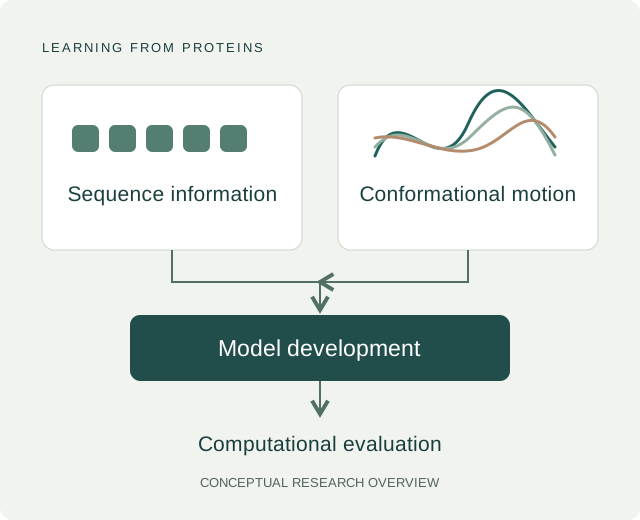
With Dr. Yi Zhang, I developed ProChoreo, a framework that connects protein sequence representations with molecular dynamics-derived conformational ensembles through contrastive learning, then uses these representations for generative binder design. My contributions include methodology, software, and computational analysis.

ProChoreo is available as a public preprint with source code. Its reported evaluation is computational. Separate, ongoing work explores agentic assistance for coordinating protein-design research; this developing direction is presented here at a conceptual level.
  • Generative modeling
  • Molecular representations
  • Research tools
Conceptual diagram connecting sequence and conformational information to model development and computational evaluation.
Conceptual research overview. The diagram illustrates information flow, not a measured result or an unpublished agent architecture.
02Published collaboration · continuing research

Enzyme Engineering

Understanding motion to inform function.

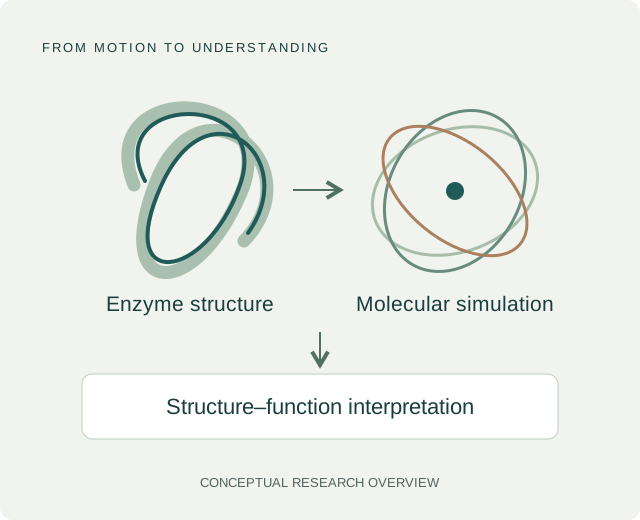
In collaboration with Han Liu (Liu Han), I investigate how enzyme structure and molecular motion relate to function.

Our published collaborative study on a cold-active transglutaminase combines computational characterization with recombinant expression and activity measurements. Molecular simulation provides a way to examine flexibility and stability alongside experimental observations.

My research interests center on using simulation and structure–function analysis to inform engineering hypotheses. Future designs and experiments are distinct from completed analyses; unpublished collaborative studies are described here only in general terms.

  • Molecular dynamics
  • Structure–function analysis
  • Enzyme behavior
Conceptual diagram connecting enzyme structure, molecular simulation, and structure–function interpretation.
Conceptual research overview. Abstract shapes represent structure and motion; no experimental data or unpublished structures are shown.
03Ongoing research

Sweet Modulator Discovery

Connecting computational ideas with experimental questions.

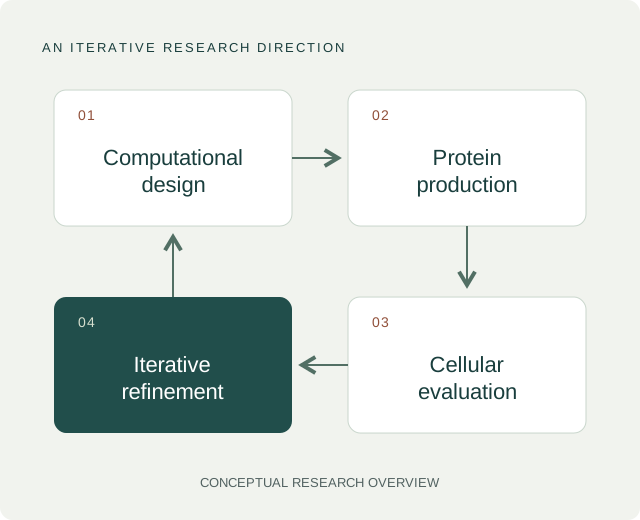
I am exploring protein-based sweet modulators through computational design, agentic research tools, and experimental investigation.

This direction aims to connect computational design with protein production and cellular evaluation, using experimental feedback to refine future designs. The broader experimental scope includes protein expression and purification, cell culture, transfection, and GPCR functional assays.

The workflow below is a conceptual research overview. It does not imply that every stage has been completed or that designed proteins have been experimentally validated.

  • Computational protein design
  • Protein production
  • Cellular evaluation
Computational design, then protein production, then cellular evaluation, then iterative refinement, with feedback to computational design.
Conceptual research overview. A planned iterative workflow, not a record of completed experiments.

Publications & software

Selected public work.

Google Scholar
  1. 2026

    npj Science of Food Published online

    De novo design of protein binders targeting the human sweet taste receptor as potential sweet proteins

    Saisai Ding and Yi Zhang

    Computational design study; experimental receptor activation and sensory sweetness remain to be established.

  2. 2026

    bioRxiv Preprint

    ProChoreo: de novo Binder Design from Conformational Ensembles with Generative Deep Learning

    Saisai Ding and Yi Zhang

    Public preprint and software for dynamics-informed binder design. Not presented here as a peer-reviewed journal article.

  3. 2025

    Enzyme and Microbial Technology · 191, 110712 Published

    A new cold-active transglutaminase: Discovery, computational insights, and recombinant expression

    Han Liu, Saisai Ding, Corinne Nardin, and Yi Zhang

Background

Across computation and biology.

Current

Doctoral research

Penn State · Food Science

Protein design, molecular simulation, and experimental protein research with Dr. Yi Zhang.

Prior experience

Industry research

Joes Future Food · GenScript

Previous work in cultivated-meat research and serum-free media development, with internship experience in gene synthesis.

Education

B.Eng. in Food Engineering

Jiangsu University of Science and Technology

An engineering foundation for research at the interface of proteins, computation, and food science.

Research toolkit

Model development

Protein representations, generative modeling, and computational evaluation.

Molecular simulation

Molecular dynamics and interpretation of protein structure and motion.

Research software

Scientific programming and reproducible computational workflows.

Experimental direction

Protein production and cell-based functional evaluation in ongoing research.

Contact

Let’s connect.

I welcome conversations about protein design, research collaboration, and opportunities across academia and industry.